
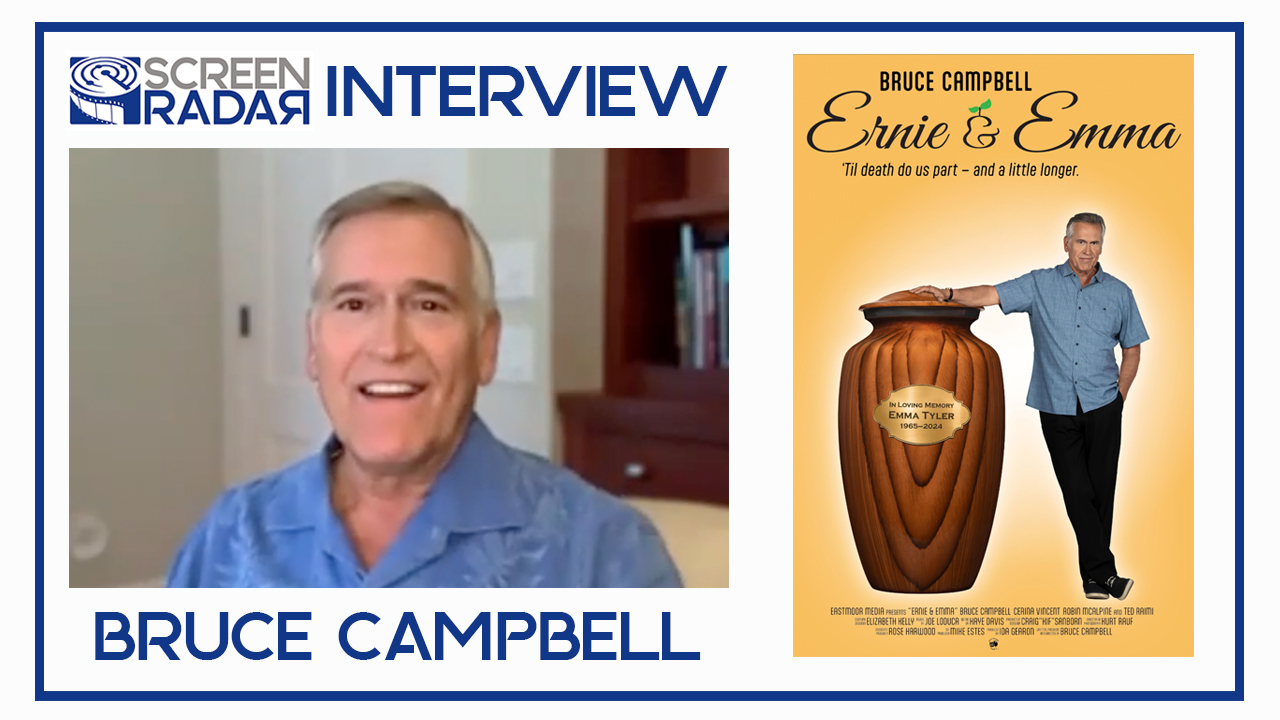
For more than four decades, Bruce Campbell has carved out one of the most distinctive careers in genre entertainment. He became a cult-film icon as the chainsaw-wielding Ash Williams in Sam Raimi’s The Evil Dead, Evil Dead II, and Army of Darkness, beginning a collaboration and friendship with Raimi that would continue through films including Darkman and the Spider-Man trilogy.
Beyond the Evil Dead franchise, Campbell has built an eclectic résumé spanning film, television, directing, producing, and writing. His credits include Bubba Ho-Tep, My Name Is Bruce, The Adventures of Brisco County, Jr., Jack of All Trades, and a memorable seven-season run as Sam Axe on Burn Notice. In 2015, he strapped on the chainsaw once again for Ash vs Evil Dead, reprising the role that first made him a cult favorite more than three decades earlier.
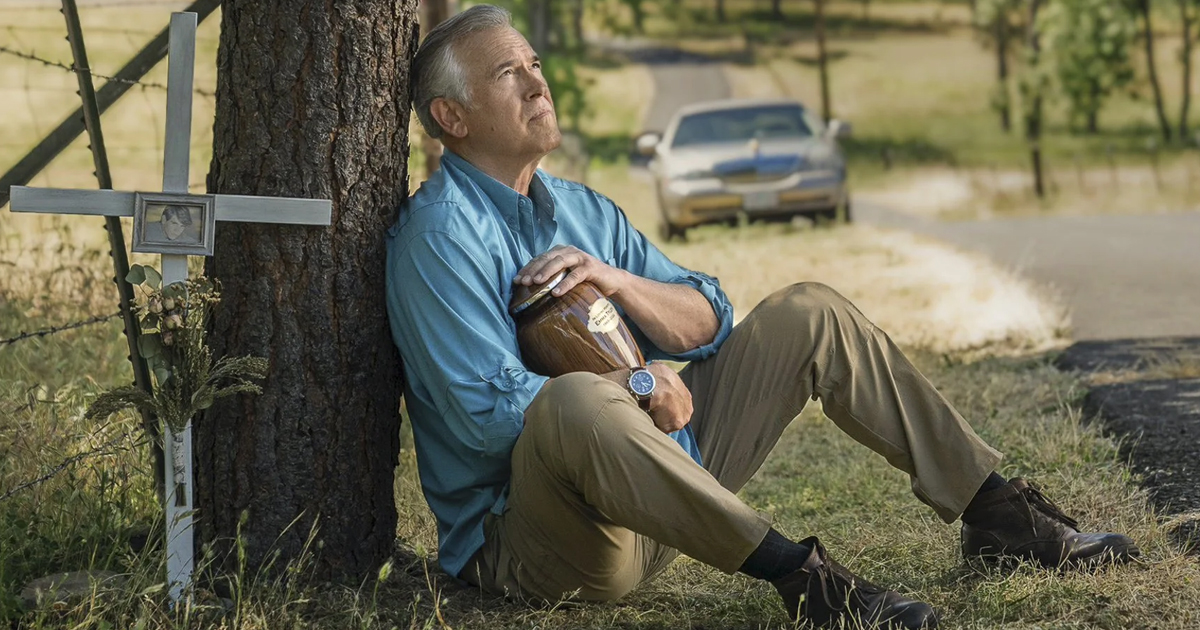
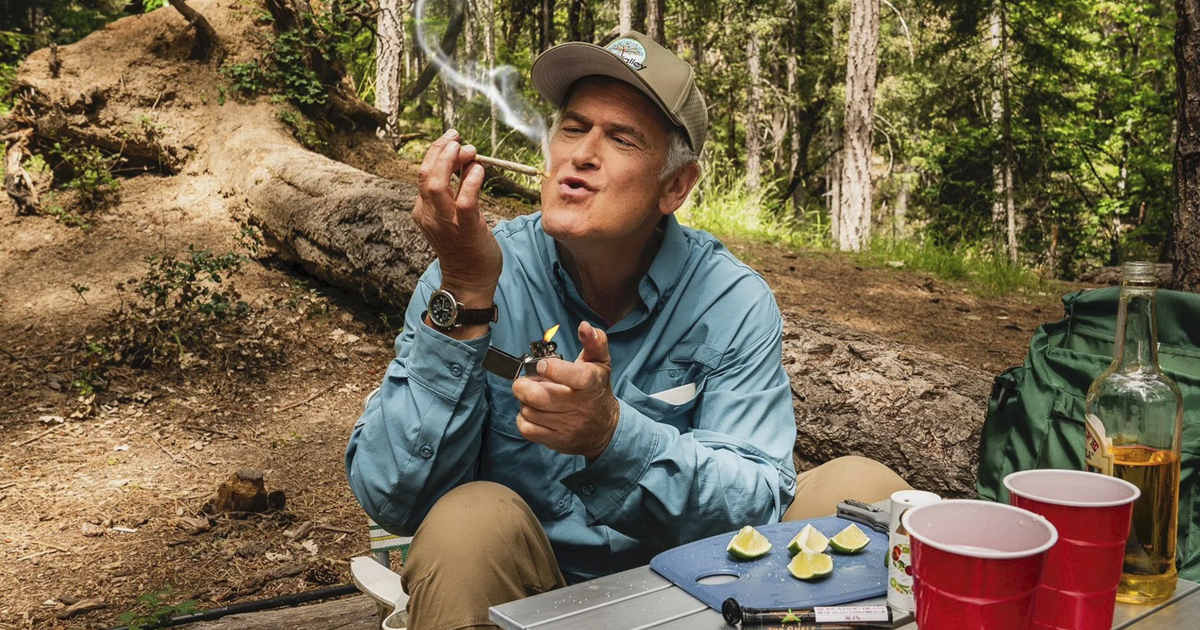
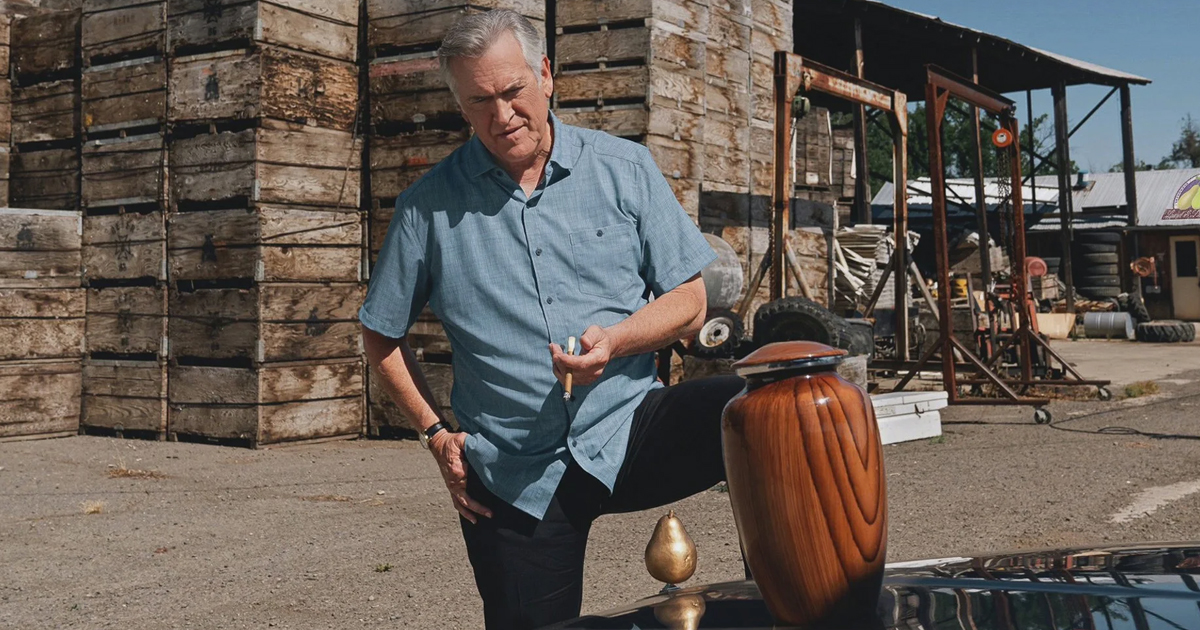
His latest starring role is in the independent film Ernie & Emma. The film, which was written and directed by Campbell, follows Ernie Tyler, a widowed pear salesman who sets out on a journey to scatter his late wife Emma’s ashes in locations she specified before her death. Along the way, Ernie reflects on their life together and confronts his grief, ultimately finding a renewed sense of purpose.
To celebrate the film, Campbell is bringing Ernie & Emma to 18 Alamo Drafthouse locations for special one-night-only screenings followed by a live Q&A.
We spoke with Campbell about bringing Ernie & Emma to the screen, the creative freedom of independent filmmaking, working alongside his wife, Ida, the challenges of directing himself, and how decades of experience in film and television have shaped his approach to filmmaking (as well as a bit of discussion about Lawrence Welk and digital butts).
Thanks for taking the time, and congratulations on the film.
Thanks. We’re right in the middle of the tour. We’re a third of the way through now.
How’s the tour going?
Good, good. You know, we’re selling out the Q&As, which is fine, but we need the residual effect of the people seeing it for the other days that it’s there, because each place I go to, they’re graciously keeping it for one week, one screen, one time a day. So, we want to get like four or five people in each of those screenings too.
Well, I thought it was fantastic. I thought you did a great job. I thought you were great; the script is great. I really enjoyed it.
I appreciate that. You know, it’s not a studio production. It’s my wife, and I have been discussing it over the past, me more than her, stomping around going, “You know, one day, one day we’re going to do this.” It’s like, “Yeah, look in the mirror, buddy.”So, she kind of let me pull the trigger. I give my wife Ida a lot of credit, because she has a lot of production experience, and I think she knew in her heart that she knew that it was doable. You had a guy talking to an urn for a lot of it, and that’s manageable. A lot of people are like, “Why didn’t you make a horror movie?” I’m like, “Too many moving parts.”
You mentioned that it’s just you and an urn for the most part. Was that a challenge for you? You wrote your script in which you’re talking to yourself for 90% of the film. How is that as a challenge as an actor, especially since you’re directing yourself as well?
The challenge I feel is no different than anything else. You have to structure your story. Figure out how you want to do it. When do you drop the bomb on them? How does he deal with it? When do things start to turn sunny? So as long as in your head, you have those beats as an actor, you know where you fit in the puzzle, because I wrote it and I’m directing, and I can help myself be where I need to be at that time.
You know, the goal of this part of it is to write a fat part. You get into the golden years, and those go to a select few: the Kurt Russells, the Paul Giamattis. They don’t go to the Bruce Campbells. I have too much genre background. If I pitched this at a studio, they would have turned it down. They wouldn’t have taken Serena Vincent. She has too much of a genre background, and yet I thought she was delightful in the movie.
I used two cuts of music from a guy named Burt Kempfert, one when Ernie’s putting his rig together. That would have been a fight if this was a studio. They would have gone, “Who’s Burt Kempfert?” And I go, “It doesn’t matter. I want Burt Kempfert.” And they would have said, “Why are you paying this much for a guy that nobody cares about?” I’m like, “What, you’re going to want Taylor Swift?” I mean, what are we doing here? So, this type of filmmaking is really liberated because it saves about 48 phone calls.
You mentioned working with your wife, Ida. This is not the first time you’ve worked together, but how was this experience different for you?
Well, we met on a movie 35 years ago, so we’re comfortable on a film set. We argued very little on this production. We should make more movies together because we had a singular vision and we knew what we were trying to accomplish. We had worked on reasonable budget stuff before together, so we knew the limitations. We knew how fast we had to make it.
We also knew you had to hire people who could do what you needed to do in that timeframe. You have to actually hire adults who are professionals in the film industry. If you want to make a movie in 27 days, which is what we did, you can’t kind of sit around and scratch your head. If that’s your MO, you’ve got to really go. So, it was really great. She gets the next one, though. I don’t get the next one. She has a bunch of stuff that she’s developed over the years, so we have a handshake deal that nobody gets to make another one until the coffers are topped up. So, if they are, in fact, she gets to pull the trigger next time. And I will, I will support her willingly.
Where did the idea for the plot of the film come from?
Weird influences over the years. You know, now that I’m 68, a bunch more has happened. I’ve seen close friends die, divorces, success, failures. You see more of that. My dad was an ad guy in Detroit. He was a fifties, sixties, seventies, even into the eighties, ad guy. He lost an account when he was an account supervisor, and he got fired when he was 50, and a 50-year-old ad guy is going nowhere fast. And so, I watched him panic. He was in a blue panic for a period of time. He finally landed a job at a crappy ad agency doing crappy car commercials, but I was an up-and-coming actor, so I was happy to be in his crappy car commercial. In the movie, when Ernie’s flipping channels, there are two seconds of a car commercial that I did with my dad.
So, I had a lot of sympathy for his scenario. I watched the car industry die in Detroit. In my valley, I’m actually watching the pear industry die. You know, those orchards that we had, those are real orchards where real pear trees are cut down because they’re going to make them probably into wine. We used to be beer and meth. Now we’re weed and wine.
Is that an upgrade?
That’s a click up. That’s one click up.
Are you critical of your own performance as a director?
You have to be, sure. But you’re critical to be protective. You go, “Oh, I’m not using that take.” Whereas that could have been used easily by some rando director who’s not on the lookout. I prowl. I look out. I pay attention.
Are you able to objectively know when you’ve gotten the take right?
I feel it. There’s a scene where he’s bitching his wife out at the hospital, like, “You went first, you screwed my life up.” That was two cameras doing that take three times, without stopping. So that was the second take of three, because after the first one, I was like, “I’m not there yet, but now I’m ready to get there.” A director off set would not have known that. So, I can go, “Just keep rolling, guys. I’ll tell you when to stop.” And so, take two, I thought I got it, but then you, as an actor, you always want to know, “Let’s try it one more time.” So, then you go back into editing, and you look at your notes and try and make sense of them and put your performance together.
And editor Kay Davis, who goes back to Evil Dead II, gets the first objective look. She sees all the footage. I’m not sitting over her shoulder when she’s assembling it. She’ll look at script notes. We have notes about what we think are the best, but she has to look at all the footage and then have a whack at it. When do you go here? When do you go here? When do you go to a drone shot? I have a fairly good idea of what I want, but a lot of times she’ll put something together, and I’ll go, “Great.That’s not what I was thinking, but that’s kind of cool. Let’s just do this one thing and then we can move on.” So, I’m as critical as I can be of being myself. I look back now, I would tinker with it a little more, but you know, you fight with the army you got.
It’s been almost 20 years since you’ve directed something. Has the process changed for you at all? How have things changed between then and now, or haven’t they?
They’re easier. The same challenges are there. You have to figure shit out. Well, you have to write a script, and then you have to see if you think the script is solid. Then you basically go through the steps. You hire the people that you think you should hire. And then when it comes time to finish… I was almost going to put it out for some previews to get some feedback. And I went, “Well, wait a second. Then I’m no different than the studio.” Do I really want to care what someone at a university thinks of act two? Is someone in a rest home going to tell me, “Pick up the pace of act one or your reversal should come sooner than page 75?”
I got to use my gut on the entire project. And I recommend that for anyone in the arts. You have to mostly go with your gut because outside elements aren’t your gut. Sam Raimi likens it to an ocean liner. He’s got all these great people working on this ocean liner, but every person is steering it just incrementally different from where he was. He says, most of his time, he’s doing micro readjustments to keep the ocean liner always on track. And that makes sense, even down to the scale of our production. But, you know, it starts with who you hire. You don’t hire someone that you’re going to have a problem with.
You’ve worked with a lot of fantastic directors. So, as a director, do you find yourself taking inspiration from the director you’ve worked with? Or are you trying to go out of your way to avoid comparisons to other directors’ work?
No, I don’t try to avoid or steal. I’ll steal and avoid. It’s a whole mixed bag. I learned from television how to make my day. I’m very grateful to Warner Brothers Television in the 90s. I spent a lot of time on TV film sets where it’s like, “Come on, let’s get this done. The old timers were all like that. Clint Eastwood’s My Hero was done at three o’clock every day. And his movies seem to do okay. I just I don’t like when filmmakers when they brag about 18-hour days. I go, “You need more experience, young fella.”
Would you say that your experience on television had a direct influence on how you manage your time on this film?
I appreciate time. I cut my teeth in New Zealand directing Hercules and Xena. 12 hours, seven to seven. You’ve got this great crew for 12 hours. But beyond that, they don’t really want to work. American crews work twelve, fourteen, sixteen, eighteen hours. And you don’t even have to ask in America. You announce to the crew, “We’re doing three hours of overtime, and they go, “Ugghh, okay.” And it costs producers an arm and a leg. In New Zealand, you come up to the assistant director on set, you go, “I’d like an hour of overtime.” And then he goes to ask all the crew heads, and they go, “No, no we’re good. The first day I ever directed, I asked for an hour. And they said, “You’re new. You get one. This is your mulligan. In six years between two shows, I never asked for another hour of overtime. It really trains you not to waste people’s time.
It also keeps the energy up. When someone knows they’re going to get out of there at 7 pm, and they’ve got a dinner reservation at 7:30, they’re working their ass off. If you don’t know when you’re going to get out of there, it’s like communism. “What’s your rush, comrade? What’s your rush? No one gets ahead. We’re never getting out of here.” Here we have energy making these movies with a trim budget.
We have an appearance from your old buddy, Ted Raimi, and Sam’s daughter, Emma.
Yeah, it’s contractual with Ted, because Sam knows that Ted needs help. But look, Ted makes me look subtle, so, Ted’s a good addition to anything that I do. Sam forced me to put his daughter Emma in, by the way. I’m calling Sam out a little bit here. He gets me on the phone. He goes, “Great news, Bruce.”I’m like, “What? He goes, “You’re going to use my daughter in your movie.” I went, “Really? Did I ask for that?” He goes, “No, no, no. But you’re going to put her in.” I go, “Really? What part would I give her?” He goes, “Oh, it’ll be something good. Don’t worry about it.” Like me telling me Don’t worry about it. “Oh, okay.” Click. Next thing you know, she’s in the movie.
We did have a part. She’s related to Ted, and all of their relatives were from Eastern Europe. So, that morning, I said, “You know, I think you guys would be better if you had a Slavic accent,” and within four seconds, they did. So, that’s the fun of working with the Raimis.
Is there a con to it?
No, I’ve had a ton of fun with Sam. Sam is just really difficult. He makes you use everything you’ve ever learned, on the technical side and on the acting side. And you just have to be ready with a lot of energy when you work with Sam, which is there’s nothing wrong with.
Speaking of actors, these are all local Oregon actors, correct?
All Portland.
What was the casting process like for you?
It was shockingly simple. I found a company in Portland. They gave random recommendations, and she had a system that worked great. You say, “Okay, this is the mailman.” She put up six faces and clips of each mailman doing the scene from the movie, because I sent them all the scenes that they needed. And then I go, “I want mailman number three.” And they go, “Okay, cool.” Then you go to the next go to the next part. It was really a joy.
They all had one-day parts. I swear to God, they came down. They did their part. They left. There wasn’t a stiff in the bunch because they were like, “Yeah, cool. Let’s make a movie.” I think they thought it was fun on location. I’m a benevolent dictator. So, we do tend to have fun. And if these guys have ideas, it’s all great. So that was a joy. And now I have a bunch of actors. I can go, “Oh, I want to get that guy for that and that guy for that.” You get a stable together of people.
Was this your first onscreen nudity?
No, that was digital. That’s digital. Oh, that has come up at every Q&A. Is that my butt? It’s a digital butt for a bunch of reasons. One is it’s a drone shot that pulls way back. If you want to hang on to any definition and/or the crack included in that definition. Not trying to be crass here. You can also determine the pink, tan, whatever nature of the butt you want it to be. It’s way more control. And so on top of everything, I wasn’t really going to show my pimply ass to the world.
So, there was a discussion about, like, the skin tone of your digital buttocks?
Sure. I want a healthy skin tone. It would be more pink than anything. It’s got blood pumping through its veins.
I’m curious, do you personally have an affinity for Lawrence Welk?
Yes. Lawrence Welk got me through seven seasons of Burn Notice.
How so?
Yeah, well, I blow shit up during the day, catch the spies, beating people up, throwing people in the trunk, sweating my ass off, and then come home, and everything’s fantastic. Lawrence Welk is on. Ridiculous costumes from the 70s. PBS was running the entire collection and its hundreds of shows, starting, I don’t know, really 50s, 60s, 70s, 80s. And I got to know every character. I got to watch Lawrence fuck up 90% of his introductions. I got to know some backstories on these, on the singers, the dancers.
And just stylistically, even if you even if it’s cheeseball, they had fresh wardrobe for these people; every show brand new, custom, ridiculous, over-the-top outfits for an entire band and everybody in the group, which had to be 40, 50 costumes for every show that were of the period, and I’m talking the wide lapels. Oh my god, it’s such a beautiful time capsule of long sideburns, no sideburns, buzz cuts. They go through it all.
And then watching the performance change over the years. So yeah, I was a legit fan. And I thought, “You know what, I’m putting some Lawrence in this.” It was hilarious to call the Welk organization. And one of the women who used to be on the show works for the organization. So, I’m talking to her on the phone, I go, “Wait, I know this woman.” You know, so we arranged to get a quote and a few clips. I thought his quote was good for the movie.
Is there a game plan after the tour?
To either tour more or try and find an actual distributor that we can go to, i.e., Sony, which owns Alamo Drafthouse. Maybe someone there will run some numbers and go, “Well, those were terrible per screen.” But yeah, we’ll try and sell it along the way. I had a long relationship with Alamo over, you know, 25 years, so I’m like, “Let’s do this.” And it’s been really a blast.
Good luck to you, sir. I just want to say that your work has meant quite a lot to me and countless other people over the years. So, on behalf of myself and all your fans around the world, I just wanted to thank you.
Thank you. I’m not officially done yet.
You at least have to make another one with Ida. I mean, you’re on the hook for that.
Yeah, I am.
Thank you, Bruce.
Thank you.
You can watch our full interview with Bruce Campbell below.
For more information about Ernie & Emma, visit www.ernieandemma.com.